
Heat Recovery | Pinch Analysis | Process Integration
Heat Recovery Studies for Industrial Sites
Find out where recovered heat can create the greatest value for your site before investing. From a Heat Recovery Screening to a Full Heat Recovery Analysis, we combine the Pinch methodology with practical process engineering and economic evaluation.
10–40% lower thermal energy demand
Indicative potential within the assessed scope; actual results depend on the site.
Screening or full analysis? Take the 1-minute check →
☏ You can also reach us here:
☎ Call +41 78 722 2200
✉ E-Mail [email protected]
Or visit our contact page to get in touch with our energy consultants.
Heat recovery studies: from screening to full analysis
Does your site need a detailed study, or is the next heat recovery measure already clear? We help you answer that question first. The aim is a technically feasible, economically sound concept and a clear decision on what to do next.
YOUR NEXT STEP · 5-QUESTION CHECK
Does your site have heat recovery potential?
Screening or full heat recovery analysis? Answer five short questions for an initial recommendation on where to start. No detailed process data needed.
Start the quick check · about 1 minute
YOUR SUGGESTED STARTING POINT
Review your five answers
Your result and answers will be added to the enquiry form below. Review and send when ready.
An initial orientation, not a quantified savings assessment. Our engineers confirm the appropriate scope with you.
Why heat recovery?
Heat recovery can be one of the most effective and economical ways to improve industrial energy efficiency. Many processes release heat while other streams still need heating. Reusing that heat can reduce purchased energy, operating costs and CO₂ emissions.
The useful question is where this heat creates the greatest value for your site. We assess heat sources and heating needs together, including temperature levels, operating conditions and the investment required.

Our Pinch Analysis approach identifies a technically feasible and economically optimised heat recovery and utility concept. Typical thermal energy demand reductions are 10–40%, with typical payback periods of 1–4 years for equipment and implementation. These are indicative ranges; actual results depend on the site.
Energy, cost and CO₂ savings are assessed separately. Cost and emissions reductions depend on the energy displaced, the supply system and the proposed measures.
What the study provides
- Clear heat recovery targets and minimum heating and cooling requirements
- Assessment of heat recovery, heat pumps and utility integration
- Technically feasible measures, prioritised for implementation
- Economic evaluation of investment, operating costs and payback
- A sound basis for decarbonisation and energy-supply planning
Why analyse before investing?
Implementing the first visible heat recovery opportunity may deliver savings. It can also tie up a heat source that would create greater value elsewhere in the process. Local measures can block better cross-process solutions. A site-wide view helps identify these interactions before equipment and investment decisions are fixed.
Our approach uses the Pinch methodology to assess heat availability and demand across temperature levels, then combines this with practical process engineering and economics. The aim is to find the heat recovery and utility concept that makes the most sense for your site.
The level of study should match the decision. Not every project needs a full analysis. A screening can show that selected measures are already clear enough to proceed directly to concept design.
Why Anytherm
Heat recovery engineering and energy consulting — under one roof.
Anytherm brings together practical heat recovery engineering know-how and systematic, scientifically grounded energy consulting. This distinctive combination connects rigorous analysis with technically feasible, economically justified solutions for your plant.
Product-neutral advice
Our consulting remains solution- and product-neutral. We assess the technologies and suppliers that suit your process and compare investment with operating costs, energy use and CO₂ effects.
Practical engineering knowledge
We bring experience from developing and engineering heat recovery equipment for exhaust air and flue gas applications. Process requirements, temperature levels and operating constraints are part of the assessment.
Support through implementation
We can help translate study findings into engineering decisions, review designs with your team or EPC contractor, and support technology and supplier selection. The study provides a basis for the next investment decision.
Our offer
We usually recommend starting with a Heat Recovery Screening: how much potential is there, how complex is the process, and what decision needs to be made? We increase the depth of analysis where it adds value, with support available through engineering and implementation.
01
Heat Recovery Screening
A structured first view of potential and the right next step.
02
Full Heat Recovery Analysis
A detailed heat recovery and utility concept for the entire site.
03
Study updates & rollout
Update existing concepts or adapt them to additional sites.
04
Implementation support
Independent support through engineering, procurement and implementation.
Screening or full heat recovery analysis?
A Heat Recovery Screening establishes the approximate potential and the right next step: a Full Heat Recovery Analysis, direct concept design of selected measures, or no further investigation. Where the potential, scope and available data already justify a detailed site-wide concept, starting directly with the full analysis can be appropriate.
Usual starting point
Heat Recovery Screening
A fast, structured overview before committing to a detailed study.
- Understand the main energy consumers and waste heat sources
- Estimate the order of magnitude of heat recovery and CO₂ reduction potential
- Decide between full heat recovery analysis and direct concept design of selected measures
- Align stakeholders and define the data needed for the next step
Detailed site-wide concept
Full Heat Recovery Analysis
For a cross-process concept with technical and economic evaluation.
- Assess several heating and cooling tasks at different temperature levels
- Develop an investment-optimised site-wide concept, balancing CAPEX and OPEX
- Evaluate heat pump, CHP and utility integration where relevant
- Prepare a prioritised measure package for implementation planning
Screening work carries forward. If you proceed to a Full Heat Recovery Analysis, the process review, available data and findings from the screening form the starting point for the detailed study. This work is not lost. In most cases, starting with a screening keeps the initial commitment low without materially increasing the total time or cost of a subsequent full study. The actual effort depends on site complexity, data availability and operating conditions.
1. Heat Recovery Screening
A Heat Recovery Screening is a pragmatic way to identify major energy consumers, waste heat sources and the overall heat recovery potential of a plant. We estimate the order of magnitude of achievable energy and CO₂ savings and recommend the most effective next step.
What we assess
- The overall site, processes and main energy consumers
- Relevant waste heat sources and heating needs
- Approximate energy-saving potential and improvement opportunities
- Whether a full heat recovery analysis or direct design of selected measures is appropriate
When screening makes sense
- Industrial plants with continuous or batch thermal processes
- New plants or retrofit heat recovery projects
- Heating and cooling tasks at different temperature levels
- Annual thermal energy costs typically above EUR 200’000
Questions answered
- What is the site’s approximate thermal energy demand?
- What savings appear achievable, in order of magnitude?
- Is a full heat recovery analysis justified?
What you receive
- An initial assessment of energy-efficiency and CO₂ reduction potential
- Heat recovery opportunities with rough quantification
- An optional Sankey diagram of key consumers and losses
- A basis for early consideration of relevant public funding
2. Full Heat Recovery Analysis
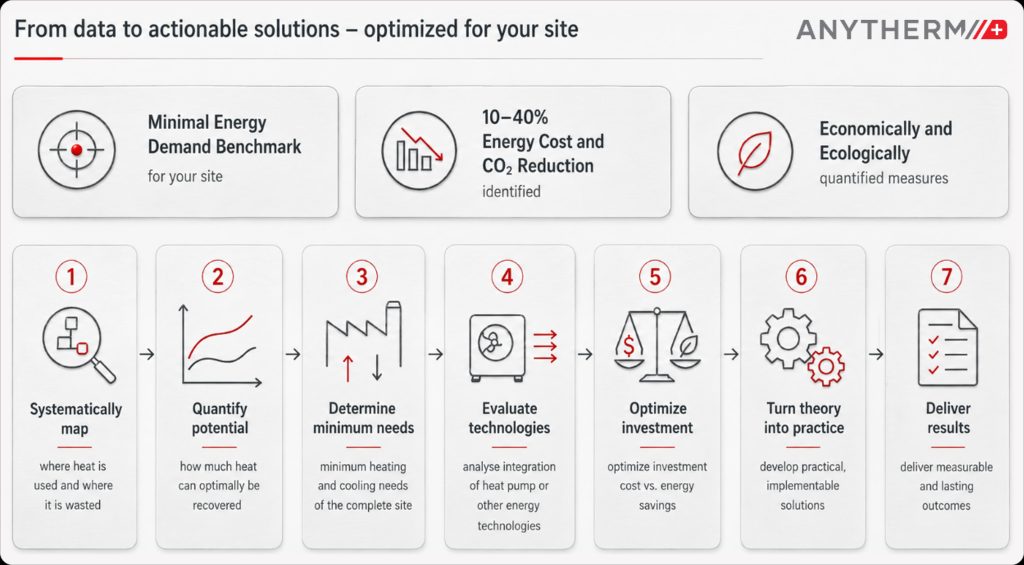
A Full Heat Recovery Analysis develops a detailed, site-wide heat recovery and utility concept. We use the Pinch methodology to establish the thermal benchmark, then assess practical heat exchanger networks, utility integration and economics. The result is a prioritised package of feasible measures for implementation planning.
Key benefits
- Typical thermal energy demand reductions of 10–40%, depending on the site
- Assessment of CO₂ reduction and links to a net-zero roadmap
- Typical equipment and implementation payback periods of 1–4 years
- Evaluation of return on investment, net present value and long-term value
Typical scope
- Cross-process analysis of the plant and its energy supply
- Heating and cooling tasks at different temperature levels
- Heat recovery and heat exchanger network concepts
- Integration of steam, hot water, heat pumps, CHP and other utilities
When a full analysis makes sense
- Industrial plants with continuous or batch thermal processes
- New plants and retrofit projects
- Several heating and cooling tasks across temperature levels
- Annual thermal energy costs typically above EUR 200’000
Questions answered
- What is the minimum energy demand of an optimised process?
- Where is the economic optimum between investment and operating costs?
- Which measures can achieve this in practice?
- Which energy supply and utility integration best suit the site?
What you receive
- Quantified energy and CO₂ saving potential
- Feasible heat recovery and energy-supply measures
- Recommendations for heat pump, CHP and utility integration
- A measure catalogue with costs, benefits and payback
- A prioritised implementation roadmap
How Pinch Analysis works
The method combines a thermal benchmark with practical process engineering and economic evaluation.
- Collect the process streams. Identify heating and cooling needs, temperatures, heat loads and operating conditions. Challenge process requirements to reveal improvement opportunities.
- Create the composite curves. Combine hot and cold streams into a site-wide picture of heat availability and demand across temperature levels.
- Identify the theoretical potential. Use the curves to establish a heat recovery benchmark and the minimum remaining heating and cooling requirements.
- Evaluate ΔTmin and economics. Balance the additional heat exchanger area required for greater recovery against the resulting energy savings.
- Develop a practical concept. Check layout, operability and economics, and assess heat exchangers, heat pumps and utility options where relevant.
Three concrete outputs
- Energy benchmark: minimum heating and cooling requirements for the site
- Quantified opportunities: energy, cost and CO₂ savings evaluated for the proposed measures
- Prioritised measures: technical and economic recommendations for implementation
How we conduct your study
1
Data preparation
Understand and challenge the current energy situation.
- Data extraction, process review and balances
- A stream table of relevant heat sources and sinks
- Energy flow diagrams and selected P&IDs
2
Analysis and modelling
Determine the heat recovery benchmark and assess options.
- Confirm process conditions, scope and requirements
- Pinch modelling, composite curves and heat exchanger networks
- Utility, heat pump and CHP options where relevant
- A list of measures with economic indicators
3
Practical adaptation
Turn theoretical potential into implementable measures.
- Verify technical and economic feasibility
- Refine the heat exchanger network and measures
- Recommend and prioritise implementation packages
Discuss your site, available data and objectives with our engineers to define the appropriate scope.
3. Study updates & multi-site rollout
Build on an existing heat recovery study or adapt a proven concept to additional sites. We review the assumptions, check current operating conditions and define the appropriate next steps.
Update an existing study
- Review the study and challenge its recommended measures
- Update production, utilities, energy prices and operating assumptions
- Adapt measures to current process conditions and constraints
- Recheck technical feasibility and implementability
- Update energy, CO₂ and economic assessments
Roll out across multiple sites
- Use a standardised approach and site-data templates
- Revalidate recovery potential and utility integration at each site
- Compare savings, investment, payback and priorities across the portfolio
- Develop a structured rollout roadmap
4. Implementation support & heat recovery engineering
Anytherm supports the journey from concept to implementation with independent heat recovery expertise. Our consulting remains solution- and product-neutral and focuses on the technically feasible, economically optimal solution.
For exhaust air and flue gas applications, we can contribute practical experience from our own heat recovery solutions. For other applications, including liquid-to-liquid recovery, we support technology selection and supplier evaluation.
Where customers work with EPC contractors, we help translate the study findings into a feasible, operable design and support correct implementation.
- Expert support during engineering and detailed design
- Joint workshops with engineering and EPC contractors
- Review of the translation from Pinch concepts into detailed design
- Support during supplier selection and evaluation
- Engineering of heat recovery systems for selected applications
Discuss your heat recovery potential with our engineers
Contact our engineering team to talk about your process requirements, technical specifications or potential energy savings.
Not sure who to contact? Send us your request and we will forward it to the right specialist:
Anytherm energy consulting: practical, competent and product-neutral advice.