
Industrial decarbonisation
Net Zero Roadmaps.
Built around your industry.
Make the next investment part of a clear long-term plan. We turn your decarbonisation goals into practical measures, compare the options and show how energy savings, emissions reductions and investments fit together.
Site-specific priorities
Built on your processes, goals and planned changes.
Technical feasibility
Grounded in operating requirements and engineering.
Comparable options
Understand costs, savings and dependencies.
Clear next steps
Coordinate investments and further planning.
Your industrial energy system
Decarbonisation starts
with your processes.
We trace how energy enters your site, where it is used and where heat can be recovered. Supply choices, process and product changes, and remaining emissions are then considered together.
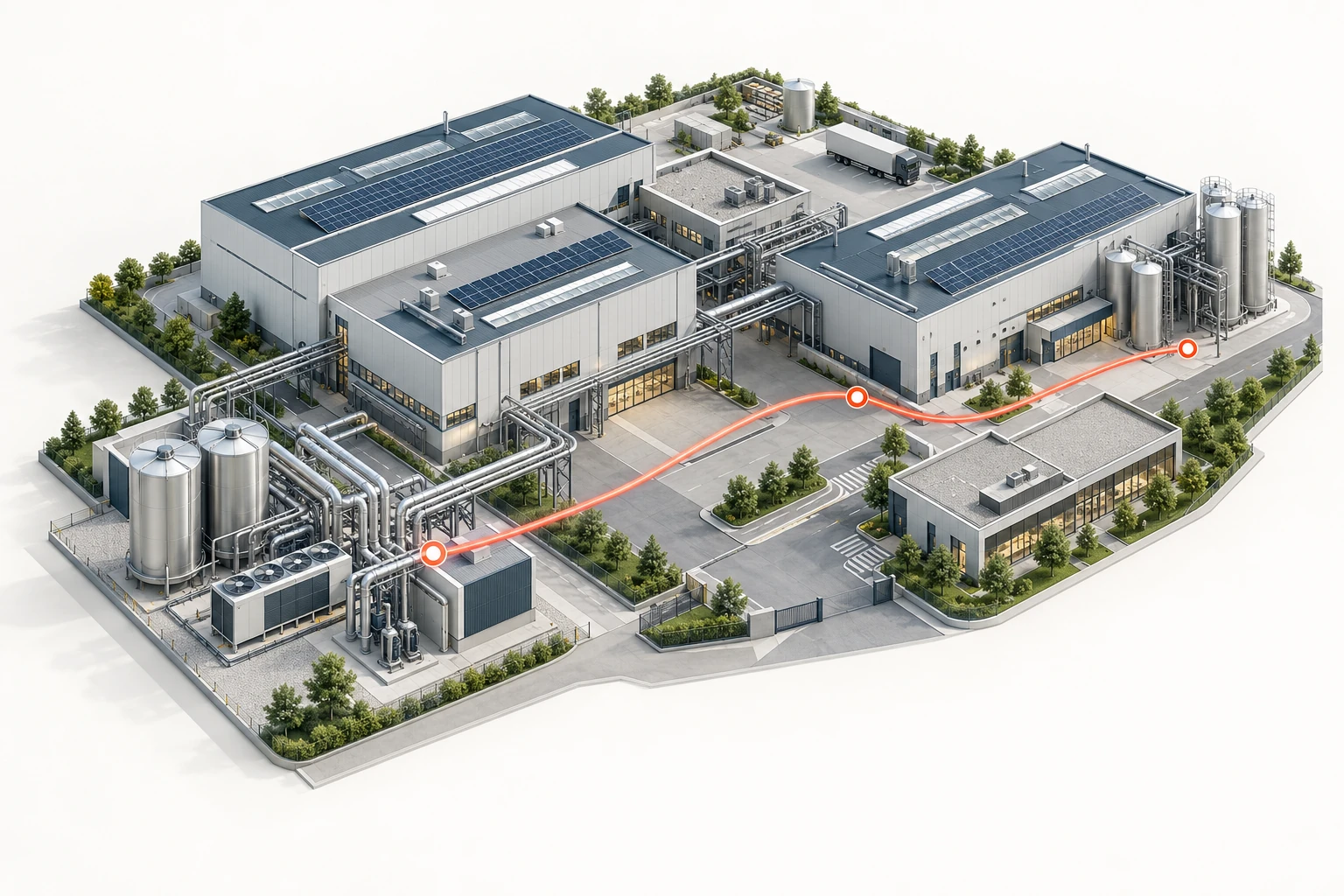
Explore an industrial energy system. Energy supply feeds production; recovered heat returns to production.
Demand & processes
Start with what
production really needs.
Review energy use alongside process temperatures, operating schedules and product specifications. Identify changes that reduce demand while maintaining production and quality requirements.
- Operating efficiency and process improvements
- Load profiles, operating hours and avoidable losses
- Temperature requirements and alternative technologies
Heat recovery & integration
Put available heat
to work again.
Connect heat sources and consumers within your site or across its boundaries. Assess temperature levels and operating schedules to identify realistic recovery and integration options.
- Process and exhaust air heat recovery
- Heat and cooling networks, heat pumps and storage
- Pinch analysis where a detailed study is needed
Supply & electrification
Match the supply
to the remaining demand.
Compare energy sources and supply technologies after considering efficiency and heat recovery. Assess technical requirements, availability and costs together.
- Electrification and renewable energy supply
- Required temperatures and connection capacity
- Planned equipment replacements and supply options
Products, services & value chain
Look beyond
the production process.
Product design, material choices and the way a service is delivered can change energy demand and emissions. We assess relevant options and their effects on production, quality and resource use.
- Material efficiency, alternative inputs and circular product design
- Energy needs during production and product use
- Supplier, logistics and other value-chain topics where included in the agreed scope
Remaining emissions
Address what remains
after direct reductions.
Identify emissions that are difficult to eliminate. Assess relevant treatment options and requirements for balancing unavoidable residual emissions under the agreed net zero framework.
- Remaining process and other direct emissions
- Carbon capture options where applicable
- Durable removals and specialist studies where needed
Conceptual system. The relevant opportunities and study depth are defined for your site.
What you receive
A basis for decisions
you can act on.
Your roadmap connects the emissions target with the technical changes and investments needed to work towards it. We document assumptions and identify where further investigation is required.
Energy and emissions baseline
A clear starting point, with agreed boundaries, targets and planning horizon.
Prioritised measures
Estimated savings, investment needs, operating impacts and dependencies.
Comparison of implementation options
Alternative combinations and timings, assessed for feasibility and economics.
Reduction pathway and investment schedule
A phased plan aligned with planned replacements, site development and the next engineering steps.
Why Anytherm
Industrial heat expertise.
In every investment decision.
Our experience in heat exchangers, heat recovery and process integration helps us evaluate what a measure will mean in your plant. Temperature levels, operating hours, media and installation constraints all shape the solution.
Recover heat before replacing the supply
Efficiency and heat recovery can reduce the demand that a new boiler, heat pump or energy connection needs to cover.
Consider the whole thermal system
We assess how heat sources and consumers interact, including temperature requirements and operating schedules.
Connect the roadmap to engineering
The study identifies the technical questions, interfaces and further design work needed before implementation.
How we work
From site assessment to a clear plan.
01
Understand your starting point
Agree goals and boundaries. Review energy data, production processes, existing infrastructure and planned changes.
02
Identify relevant measures
Develop opportunities across your energy system, using site discussions, operating data and targeted analysis.
03
Check technical feasibility
Assess process requirements, infrastructure, operational constraints and dependencies between measures.
04
Evaluate costs and savings
Estimate investment and operating effects. For detailed studies, compare costs over the life of the options.
05
Compare implementation pathways
Combine measures into scenarios and compare their emissions, costs and timing with a reference case.
06
Define your roadmap
Select the preferred pathway together. Document milestones, uncertainties and the next planning steps.
Putting the measures together
The right sequence matters.
A roadmap shows how individual projects contribute to the overall direction. Early efficiency measures, equipment replacements and changes in energy supply are considered together.
Conceptual roadmap. Efficiency starts early, heat recovery and energy supply changes follow as appropriate, and residual emissions are assessed over the longer term. A schematic line indicates declining emissions. No project values or dates are represented.
Illustrative sequence only. Actual timing, investment needs, reductions and treatment of residual emissions are determined for each project.
Structured methodology.
Practical application.
Anytherm also carries out energy consulting assignments for EnAW (Energie-Agentur der Wirtschaft). Depending on the project scope, we draw on EnAW’s decarbonisation methodology and combine it with our practical expertise in industrial heat recovery and process integration.
Scope and next steps
A study that fits your site.
The scope depends on your objectives, site complexity and available data. We agree the level of detail, deliverables and fee before the study starts, from a focused assessment to a detailed comparison of decarbonisation scenarios.
Which emissions does the roadmap cover?
We define the boundaries at the start. A study may cover direct emissions from your operations (Scope 1) and emissions from purchased energy (Scope 2). Any extension to value-chain emissions (Scope 3), specific target frameworks or formal submission requirements is agreed explicitly.
What information is needed to get started?
Existing energy consumption data, information on the main processes and equipment, operating schedules and planned investments provide a useful starting point. We identify data gaps and any additional measurements needed during scoping.
Does the roadmap include detailed engineering?
The roadmap provides a basis for investment decisions and subsequent planning. Detailed design, procurement and implementation support can be scoped as follow-on work for selected measures.
Can existing studies and energy targets be used?
Yes. Existing energy assessments, heat recovery studies, emissions inventories and investment plans can inform the roadmap. We review their scope and assumptions before integrating the relevant findings.
Let’s look at your site
What is your next
decarbonisation decision?
Tell us about your processes, targets and upcoming investments. We will help define a suitable scope for your roadmap.