
Industry | Buildings | Energy Systems
Energy Analysis & Technical Energy Consulting
Where is energy used, where is it lost, and which improvements are worth implementing? We analyze processes, building services and energy supply systems to identify practical ways to reduce consumption, costs and CO₂ emissions.
☏ You can also reach us here:
☎ Call +41 78 722 2200
✉ E-Mail [email protected]
Or visit our contact page to get in touch with our energy consultants.
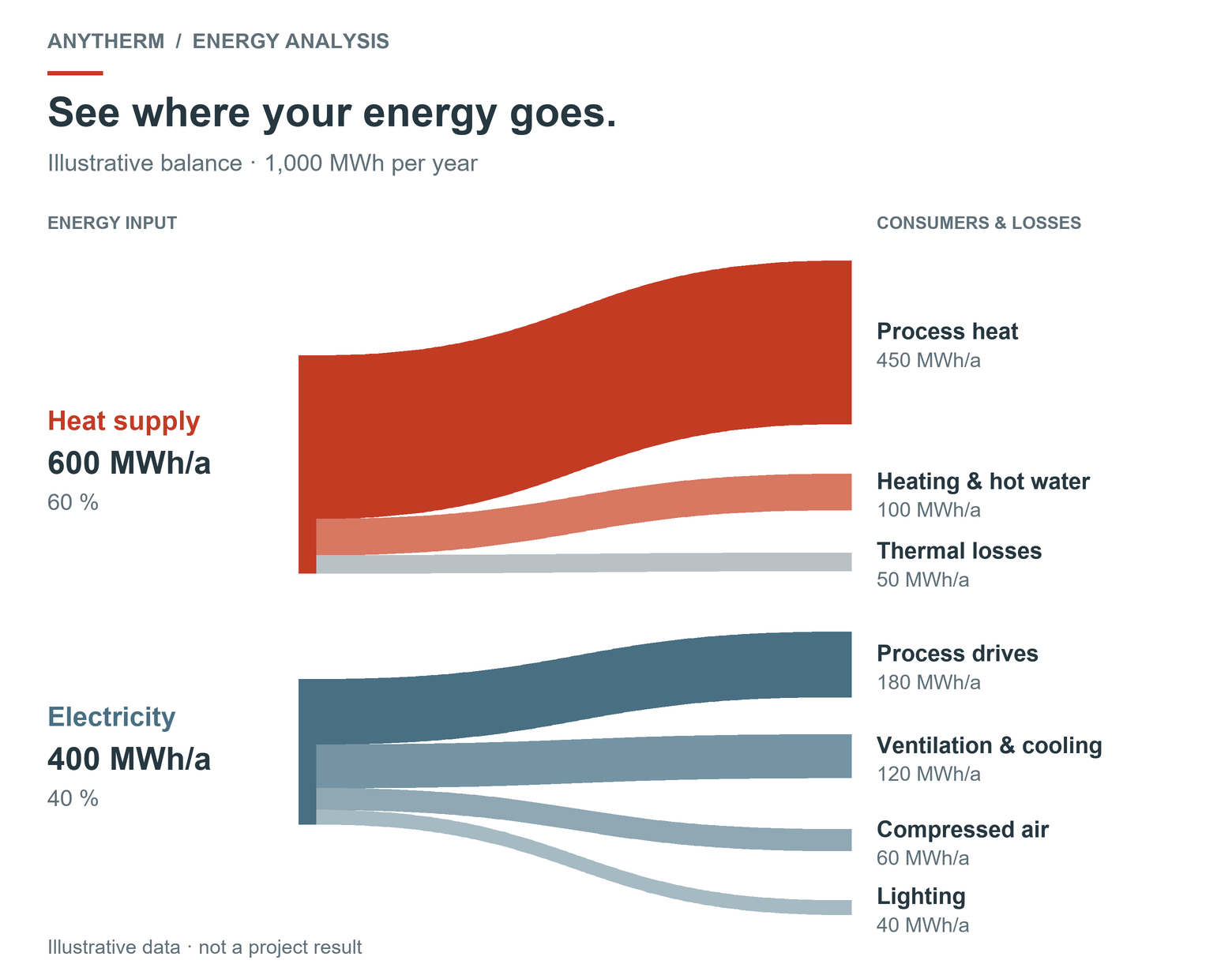
A clear picture of your energy situation
An energy analysis connects consumption data with what actually happens in your plant or building. We assess electricity, heat, cooling and fuels, identify the main consumers and losses, and develop technically feasible improvements. Our work covers industrial sites, commercial buildings, hospitals and complex campuses, from a focused equipment assessment to a site-wide energy study.
01 / ESTABLISH THE BASELINE
Initial assessment
A site visit, review of available data and assessment of major systems establish the current situation. We identify promising measures, estimate their potential and clarify where additional measurements or a detailed study will add value.
02 / COMPARE THE OPTIONS
Energy & feasibility studies
We examine operating conditions, compare technical options and evaluate their energy and economic performance. The scope can cover a single system, interacting building services or the complete energy supply of a site.
03 / RECOVER WASTE HEAT
Heat recovery & Pinch analysis
We match heat sources and demands by temperature, capacity and operating time. Where appropriate, a Pinch analysis quantifies heat recovery potential and supports the integration of heat pumps, thermal storage and more efficient utility systems. Explore Pinch analysis →
Where we identify energy savings
Heating, hot water & steam
Generation efficiency, distribution losses, insulation, temperature levels and operating schedules. Typical measures include lower network temperatures, improved control, condensate recovery and matching heat supply to actual demand.
Ventilation, cooling & air conditioning
Air volumes, fan power, pressure losses, heating and cooling setpoints, operating hours and heat recovery. We assess demand-based operation, free cooling and the use of waste heat while accounting for process, comfort and hygiene requirements.
Compressed air, pumps & drives
Pressure levels, leakage and idle operation, compressor control and heat recovery. For pumps, fans and motors, we examine load profiles, sizing, speed control and the efficiency of the complete system.
Lighting & electrical consumers
Installed power, operating hours, lighting requirements and control strategies. We evaluate LED replacement, presence and daylight control, efficient equipment, standby consumption and electrical peak loads.
Building envelope & thermal demand
Heat losses through roofs, facades and windows, insulation and interactions with heating and cooling. We compare renovation measures and their effect on energy demand, equipment sizing and summer comfort.
Processes, waste heat & energy supply
Drying, heating and cooling processes, exhaust air, wastewater and other heat sources. We compare heat recovery, heat pumps, district heating, biomass and solar energy; where suitable, also mechanical or thermal vapor recompression and other energy conversion technologies.
Results you can use to make decisions
- Energy balance and Sankey diagrams: a clear view of energy inputs, conversion, distribution, main consumers and losses. Measured values, calculated values and assumptions are distinguished.
- Consumption and load analysis: base loads, peaks, operating patterns and relevant performance indicators, with checks for data gaps and implausible readings.
- Quantified measures: annual energy, cost and CO₂ savings, investment estimates and payback periods based on documented assumptions and the agreed study depth.
- Comparison of alternatives: operating costs, temperature requirements, technical feasibility and sensitivity to energy prices, operating hours and future demand.
- A prioritized action plan: operational improvements and investment projects, including dependencies, implementation requirements and the next steps for planning and verification.
We consider measures together: for example, lowering network temperatures may enable better heat recovery and more efficient heat pumps. Interactions are accounted for so that savings are not counted twice.
Calculations, funding & technical assurance
Savings calculations & practical tools
We develop and apply calculation tools for recurring measures, including equipment replacement, ventilation, lighting and heat recovery. Before-and-after conditions, operating hours, loads and relevant weather or production influences form the basis for transparent calculations and subsequent verification.
Funding applications & evidence
We assess suitable funding opportunities and prepare the technical basis for applications: project descriptions, energy calculations, cost comparisons and evidence of results. In Switzerland, this can include support for energy studies and efficiency measures, such as EnergieSchweiz and ProKilowatt. Eligibility and application timing are checked for each project.
Technical review of energy analyses
Our experience reviewing energy consumption analyses (EVA) and the technical basis of cantonal target agreements (KZV) informs our quality assurance. We check data completeness, energy balances, savings calculations, economic assumptions and the plausibility of proposed measures.
Transport energy & emissions
Our work with the EnAW transport program also covers the technical assessment of electric commercial vehicles and shifting freight from road to rail. We evaluate activity and consumption data, reference scenarios and calculated emissions reductions, and support the evidence required by the applicable program.
For transport assessments, we examine system boundaries, route distances, loads and any remaining road transport. Reference and project scenarios must describe comparable transport services so that calculated effects reflect the actual change.
Why Anytherm
Experience with demanding operating environments
Our energy consulting combines industrial process expertise with experience in complex building operations. Practical operating experience, transparent calculation methods and qualified technical expertise shape our analyses and recommendations.
More than 20 large consumers
We continuously support more than 20 energy-intensive large consumers with substantial electricity and thermal energy demand. This ongoing collaboration brings practical operating experience into our technical analyses.
Qualified technical expertise
Our team includes energy consultants certified by the Swiss Federal Office of Energy (SFOE/BFE), with university qualifications in mechanical engineering, energy systems and sustainability.
Hands-on operational experience
We combine technical advice with hands-on operational responsibility and implementation. For many years, we have taken on these responsibilities at one of Switzerland’s largest hospitals—from energy data assessment and savings calculations to coordinating and implementing efficiency measures and preparing funding documentation. This experience informs our practical calculation tools and methods for non-standard measures.
From a technical assessment to the next step
This service provides the technical basis for improving energy performance. For ongoing energy management, ISO 50001, target agreements and organizational processes, see our Energy Management Services. For a long-term decarbonization pathway, explore our Net Zero Roadmaps.
We can also support the transition from analysis to engineering and the implementation of heat recovery systems.
Which energy questions would you like to resolve?
Tell us about your site, your main systems and your objectives. Existing consumption data, an equipment list or a specific improvement idea are useful starting points. Together, we define a scope that delivers the answers you need.
Solution-oriented, technically sound and independent advice.