
Heat transfer | Heat recovery | Energy efficiency
Industrial heat recovery systems.
Put waste heat to work.
Recover heat from exhaust air and flue gas to preheat process air or supply other heating needs. We combine custom recuperators, circulation systems and practical engineering with independent heat recovery and pinch analysis.
01
Complete system scope
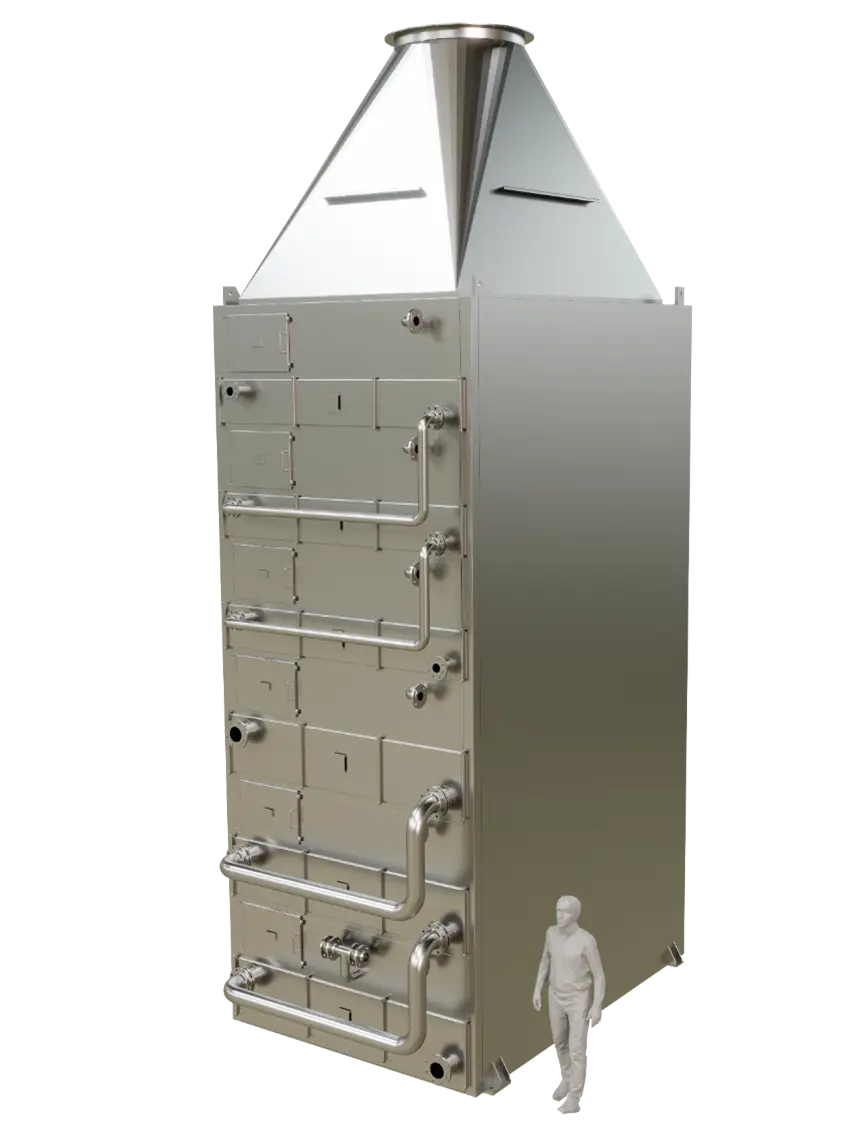
Recuperators, preheaters and pumping stations, with piping and instrumentation available from one source.
02
Direct or circulation systems
Recover and reuse heat within one unit or connect sources and users at different locations.
03
Designed for your media
Finned-tube, bare-tube or pillow-plate designs, with cleaning-in-place where required.
04
A clear investment basis
Assess useful energy savings, operating costs and payback before committing to equipment.
Connect waste heat with useful demand
The right heat recovery system
for your process.
Anytherm designs industrial heat recovery systems that connect available waste heat with useful process heating demand. Exhaust air from spray drying and flue gas from combustion processes are typical sources. The recovered heat can preheat inlet air or serve other compatible heat users.
Heat recovery circulation systems
A water circuit transfers heat between a recuperator and one or more preheaters. Heat recovery and heat release can take place at different locations on your site. Multiple heat sources and heat sinks can be connected to the circuit.

Direct gas-to-gas heat recovery
A direct recuperation system transfers heat between gas streams within the same heat exchanger unit. We adapt the design to the media, temperature levels, pressure losses, installation space and cleaning requirements.
Why Anytherm
Heat recovery equipment.
Pinch analysis expertise.
One experienced team.
Anytherm brings together practical heat exchanger engineering and scientifically grounded energy consulting. We understand how equipment performs in demanding process conditions and how it fits into the wider energy system.
Product-neutral analysis
Our energy consulting evaluates the solutions that make sense for your site. A screening or pinch analysis can establish priorities before a particular technology or equipment supplier is selected.
Equipment built around the process
We tailor materials, heat exchanger geometry, cleaning arrangements and access to your media and operating conditions, including demanding exhaust air applications.
Engineering through implementation
From thermal design and economic evaluation to pumping stations, piping, instrumentation and commissioning support, we help turn a heat recovery concept into a practical system.
Before you invest
Find the best use
for your recovered heat.
The first visible heat recovery opportunity is not always the most valuable one. Our heat recovery and pinch analysis expertise helps assess sources and heating needs together, across processes and temperature levels.
We combine the Pinch methodology with practical process engineering and economic evaluation. This provides a basis for a technically feasible heat recovery and utility concept, including heat pump integration where relevant.
Start with the decision you need to make
- Heat Recovery Screening: establish the approximate potential and whether a detailed study adds value.
- Full Heat Recovery Analysis: develop a site-wide concept and prioritise feasible measures.
- Defined equipment requirement: proceed to thermal design and system integration when the scope is already clear.
Consulting remains solution- and product-neutral. The level of analysis should match the complexity of your site and the investment decision.
Heat recuperators for demanding exhaust air
Recover heat.
Keep the system cleanable.
Dust-loaded, sticky or contaminated exhaust air requires a heat exchanger design suited to the process. We select finned-tube, bare-tube or pillow-plate arrangements according to thermal duty, fouling behaviour and cleaning requirements.
For suitable applications, cooling exhaust air below its condensation temperature can recover additional heat. Condensate drainage, material selection and cleaning must be considered together.
- Cost-efficient finned-tube units for inlet-air preheating and suitable flue-gas cooling duties.
- Cleanable recuperators with integrated cleaning-in-place (CIP) where required.
- Inspection access and maintainable components for reliable operation.
- Pumping stations, piping and instrumentation available as part of the system.
In practice · Nestlé
Delivered recuperators.
Site-wide heat integration.
Our Nestlé case study brings together two published parts of the collaboration: delivered exhaust air recuperators and a separate site-wide pinch study.
By July 2024, Anytherm had delivered three large recuperators with heat recovery capacities of approximately 1.3–2 MW per unit. The equipment includes condensation heat recovery and integrated CIP to remove powder deposits.
A pinch-based study published in August 2026 identified nearly 25% natural gas reduction potential at a Nestlé food production site. These are study findings that support further implementation decisions, rather than measured savings from the delivered units.
1.3–2 MW
Heat recovery capacity per delivered recuperator.
Nearly 25%
Natural gas reduction potential identified by the separate site-wide study.
More views of our direct heat recovery equipment
Planning your heat recovery project
From initial enquiry
to a sound investment.
What determines heat recovery system payback?
Useful recovered heat, annual operating hours, energy prices, installation cost and additional operating costs all affect the result. Payback can be around 1–2 years in suitable applications, but it must be evaluated for the actual project.
On request, we assess payback, net present value (NPV) and internal rate of return (IRR). We can also support the assessment of potential public funding where relevant.
Do I need a pinch analysis before ordering equipment?
Not every project needs a full analysis. If the heat source, useful heating demand and system boundaries are already clear, we can proceed to concept and equipment design. Where several processes compete for the same heat sources, a screening or full pinch analysis helps prioritise the most useful measures.
Which information should I include in an enquiry?
Start with your process, the available heat source and what you would like to heat. If available, include flow rates, temperatures, humidity or gas composition, operating hours, fouling and cleaning requirements, and installation constraints. Share what you already know; we can work through missing details together.
Let’s talk about your process
Discuss your heat recovery project
with our engineering team.
Have an exhaust air heat source, a retrofit in mind, or a question about your site’s potential? We support you with heat recovery equipment, independent analysis and process integration — from the first discussion through implementation.
Start with your process, operating conditions and what you want to improve. A complete specification is not needed — our sales and engineering team will help clarify the next step.
Contact our team
[email protected]
+41 78 722 2200
Your heat recovery specialist
Tobias Helbling · Head of Industrial Energy and Heat Recovery
[email protected]
Send us your request
Tell us about your process requirements, technical specifications or potential energy savings.
Prefer a little guidance? Start a guided enquiry ↗