
HOW TAILOR-MADE AIR DRYING SOLUTIONS IMPROVE INDUSTRIAL PROCESSES AND USE ENERGY EFFICIENTLY
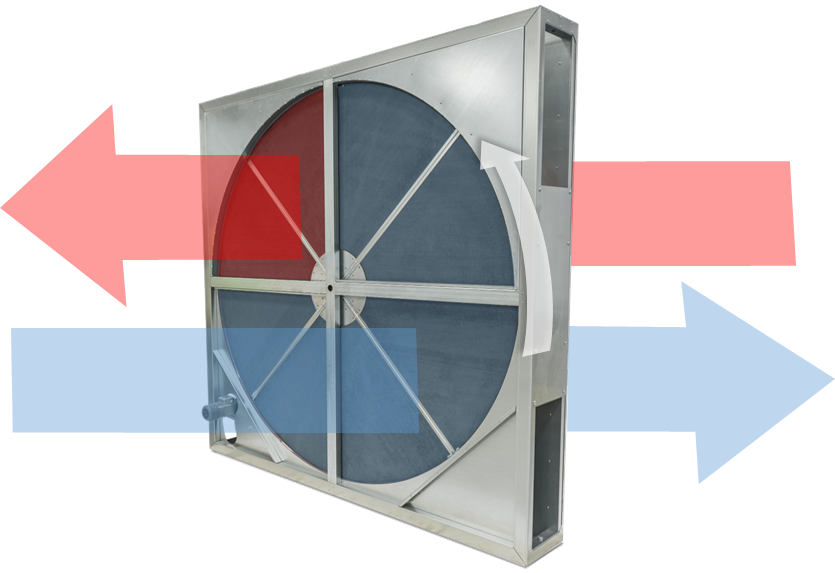
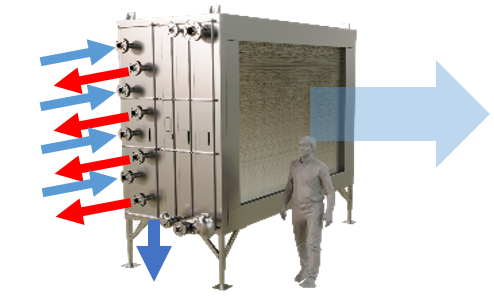
In industrial processes where air is not only a medium but also an active process parameter, the right dehumidification technology is crucial for quality, efficiency and operational reliability. Whether spray drying, spin flash drying or other thermal drying processes – wherever air humidity and temperature influence the product and process, the question of the appropriate dehumidification solution arises. Two fundamentally different technologies are at the heart of this: desiccant wheel (sorption) dehumidification and “classic” refrigeration or ice water dehumidification (condensation).
SORPTION OR REFRIGERATION DEHUMIDIFICATION – TWO WAYS TO DRY AIR
Sorption dehumidifiers use hygroscopic materials to actively bind water vapour from the air. The water vapour is stored in a sorptive rotor or fixed sorption module and then removed again by a warm regeneration air flow. This technology enables very low absolute humidity levels of less than 2 g of water per kg of air and delivers the air to the process in a warm, dry state. This is a decisive advantage, especially in applications with high requirements for residual moisture content, as it ensures constant drying potential.
In contrast, refrigeration dehumidification cools the air below the dew point. The water vapour condenses on cold surfaces and is discharged as liquid. This method achieves typical residual moisture levels of around 6 to 7 g/kg. Lower values are technically possible, but require significantly more effort, for example for de-icing, and lead to higher energy consumption. The escaping air is cold and fully saturated, so reheating is often necessary to prevent condensation in the rest of the system.
COMPLEXITY, COSTS AND PRACTICAL APPLICATION
The differences go beyond pure function. Sorption dehumidifiers are more complex systems with rotating desiccant wheel, separate air flows and higher equipment costs. This is also reflected in the investment costs, which in many cases are significantly higher than those for refrigeration dehumidifiers. In applications with strict requirements for particle-free air, additional filtration is also necessary due to the moving parts in the air flow.
Refrigeration dehumidifiers are simpler in design, which is reflected in lower acquisition costs and easier servicing. In many processes with moderate humidity requirements, this solution is economically attractive and can be integrated into existing chilled water loops.
ENERGY INTEGRATION AND SYSTEM EFFICIENCY
A key advantage of modern dehumidification solutions lies in their energy integration. Sorption dehumidification primarily requires thermal energy for the regeneration of the sorption material. Depending on the process infrastructure, this heat can come from steam, hot water or waste heat (heat recovery). The proportion of electrical energy is comparatively low, which is particularly energy-efficient in processes with existing thermal energy. Cold dehumidification, on the other hand, mainly requires electrical energy for cooling (creating ice water) and often additional reheating.
Both technologies can be combined with heat recovery systems to further increase energy efficiency. In sorption systems, heat recovery can be used to preheat the regeneration air. In refrigeration systems, waste heat from the refrigeration cycle can be used to reheat the air. Such integrative concepts reduce the overall energy requirement and improve the economic key figures.
IMPORTANCE IN DEMANDING DRYING PROCESSES
In many industrial drying processes, it is not only the dehumidification itself that counts, but also the quality of the air and its interaction with the product. In spray drying, for example, the absolute humidity of the supply air directly influences the drying performance and thus also the product quality. Sorption dehumidification enables consistently low humidity levels, even with highly fluctuating inlet conditions, thus increasing process stability. In spin-flash drying, material drying is very sensitive to changes in humidity, which requires the use of high-performance dehumidification systems. And in processes such as freeze drying, extremely dry conditions are crucial to prevent condensation or ice formation on machines.
The combination of pre-dehumidification via condensation and subsequent fine drying via sorption often proves to be the optimal approach. This hybrid operation utilises the strengths of both technologies: the high dehumidification rate of refrigeration dehumidification at high inlet humidity levels and the high final drying performance of sorption dehumidification.
ENERGY AND COST OPTIMZED DEHUMIDIFICATION SOLUTIONS WITH ANYTHERM
The Anytherm product range includes all the components required for a tailor-made and technically sophisticated air drying solution: from dehumidification technologies to air flow and heat recovery to integration into existing production processes. The result is not an isolated individual device, but a holistically planned system tailored to the specific requirements of the respective process.
A key competitive advantage of Anytherm is the combination of product expertise and energy consulting.In-depth process analyses are used to examine energy flows beyond the dehumidification system itself. Modern methods such as pinch analysis make it possible to understand the entire energy network of a plant, identify potential savings and develop measures to improve energy efficiency and reduce CO₂ emissions. The analysis takes into account not only current consumption, but also life cycle costs and long-term energy targets, resulting in economically viable and energy-efficient solutions.
This enables Anytherm to offer not only technologically advanced dehumidification solutions, but also strategically energy-optimized system concepts that reduce operating costs and increase overall energy efficiency. At a time when industrial energy efficiency has become a key competitive factor, this means sustainable added value for customers.
GET IN CONTACT WITH OUR EXPERTS – WE ARE HERE TO HELP
We are looking forward discussing your dehumidification requirements and assuring you the optimal solution, minimizing both investment (CAPEX) and operating (OPEX) cost. Don’t hesitate to contacting us, we are glad to help and discuss!
Direct contacts and phone numbers of our dedicated sales team members can be found on our CONTACT-WEBPAGE
You are welcome to write an email to sales@anytherm.com or to use our contact form:
Looking forward to hearing from you!